
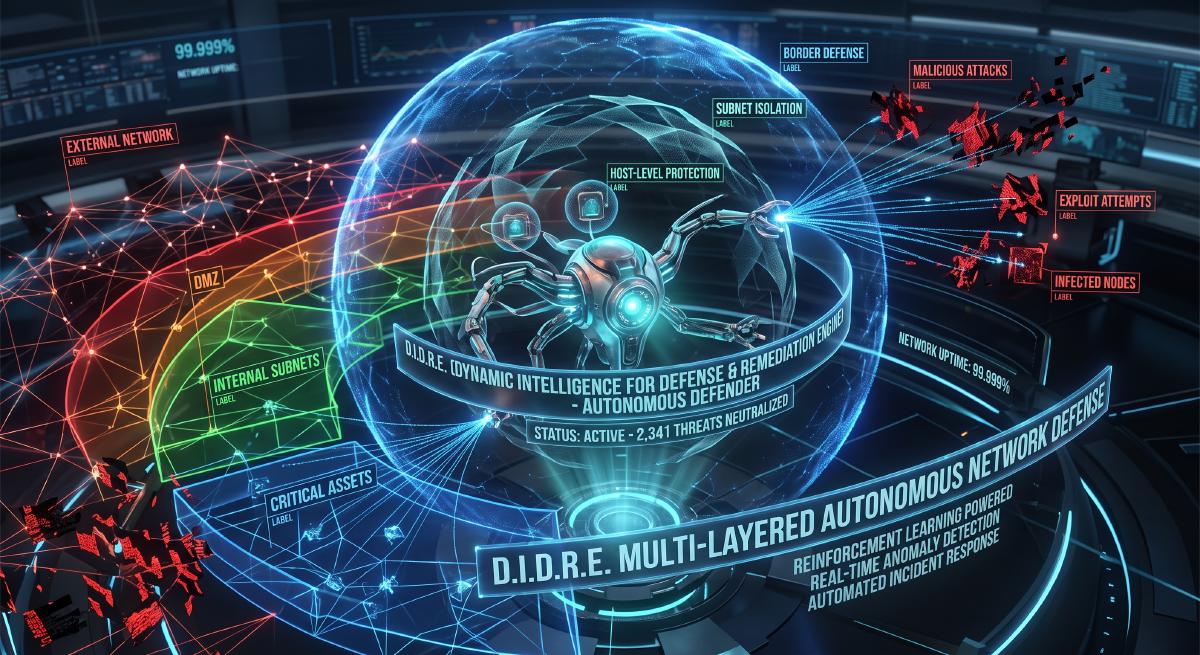
I want to tackle the big elephant in the room: how do we actually get to autonomous defense?
We have seen many examples of autonomous offense / hacking, including the OpenAI-HuggingFace incident, and threat intel reports from Anthropic and Google, revealing how human-in-the-loop involvement is dramatically reduced in attack chains.
However, defense is traditionally hard to automate due to the high cost of false positives (you may accidentally disrupt critical business operations or lock out legitimate employees if the AI misinterprets normal activity as a threat) and the complexity of business context involved in making security decisions.
As discussed in the latest Srsly Risky Biz episode, some companies require speedy, automated detection and response mechanisms to thwart threats (think crypto exchanges), while other companies have the luxury of taking their time to respond appropriately to a hack (e.g. the HuggingFace response). However, as models get more powerful and accessible by wider audiences, all businesses will need to make defensive decisions faster as well.
There is an argument that cyber security is essentially equivalent to a proof-of-work problem now, where “to harden a system we need to spend more tokens discovering exploits than attackers spend exploiting them”. As models keep getting better, and people keep spending tokens on finding bugs, it’s not hard to imagine a world where it is extremely expensive to find a traditional software bug, although we’re still a while away from that scenario - currently attackers are finding bugs easily, and the industry has coined the term “vulnpocalype”.
I’ve seen recommendations for companies to simply “patch faster”, to tackle the “vulnpocalype”. However, this approach overly trivializes the challenges businesses currently face. If they could patch faster, they would…however they need to first test the patch doesn’t break anything in their environment (see crowdstrike bug that broke the internet), and on top of that, they now need to be worried about the risk of supply chain attacks as well (see Shai-Hulud npm worm). The patching paradox: If you push the patch instantly to stay safe from the bug, you risk blindly introducing a catastrophic supply chain attack into your environment. If you hold back the patch to thoroughly vet it for supply chain integrity, you remain wide open to the original bug.
Perhaps this paradox can be solved by AI agents too: I can imagine a future where patches are tested end-to-end by agents that simulate the corporate environment to such an extent that they cover every use-case that employees would need. Additionally, in this ideal future, agents provide verifiable proof that no supply chain risk would be introduced with the patch.
I do believe that close-to-autonomous defense can be achieved, and must be sought after to tackle autonomous offense. However, my belief is that 100% fully autonomous defense will never exist (at least as long as there is 1+ human employees in the company) - mainly due to the fact that humans can still be compromised through social engineering, and no software patch can solve for insider threats. In these scenarios, we need to apply a defense-in-depth approach which balances usability with security of internal systems.
Introducing the concept of "DIDRE: The Defense in Depth Recommendation Engine"
What our industry needs is a recommendation engine that understands your business context, and complements your SOAR (Security Orchestration, Automation, and Response) tooling. When you cannot respond to an incident in real-time, you need to make defensive decisions as fast as possible. In the HuggingFace case, that involved using GLM5.2 to understand what had happened, and then making decisions on how to improve their security posture (such as fixing the initial-access vulnerabilities, revoking and rotating credentials, locking down the cloud metadata service, deploying stricter admission controls on k8s clusters, and narrowing credential scope). Each decision made was to add a layer to their defense, and make it a lot harder for the next attacker that inevitably tries to hack them again.
So, is it possible to have a recomendation engine that would understand your business context and recommend the best possible defense-in-depth measure for you in that point in time? Such a solution would have to weigh up many things, including:
- What would be the monetary cost and human effort required for implementation?
- What would the business impact be of the change? Will certain users get hindered from doing their job? What current business processes would be impacted?
- What mitigations currently already exist?
The above questions have, in the past, been answered by humans that defend networks. LLMs can be used to help them make decisions faster, especially in the cases that cannot be automated by SOAR.
What are examples of defense-in-depth measures that DIDRE may recommend, you ask? Well I have some examples of security best practices for you:
- Protect user’s accounts with 2FA (passkeys or FIDO U2F hardware keys) and strong passwords (use a password manager)
- Protect vulnerable network services by putting them in isolated networks (see network allowlisting controls)
- Require multi-party human approval for sensitive mutation actions
- Monitor for anomalous activity that strays from the baseline of how things usually are e.g. when accessing keys / credentials
- Modernize your business e.g. moving off legacy operating systems to modern ones that support modern exploit mitigations (and ask your vendors to do the same)
- Red team your public (and internal facing) attack surface to find vulnerabilities and fix them before others find them
- Keep offline backups
- Use sandboxes / ephermeral environments for CI/CD jobs and restrict pipeline credentials (see a more thorough guide for software supply chain security here)
- Prepare an incident response plan, for when things inevitably go sideways
These examples are kept high-level on purpose, as the aim should still be to automate low-level fixes with SOAR e.g. rotating credentials when an incident is detected, upgrade software package to version X, and apply ACLs on a file to remove world-readability.
My hope is that every business has their own DIDRE, that works with your security team and in the business’s best interests.
Unprompted AU
I also attended Unprompted AU last week, and absolutely loved the conference. I met some amazing people in the industry, working on high impact problems, and listened to many high quality presentations. Here are some of my takeaways and favourite presentations:
- Most of the talks were related to using AI for offense. This may be because it is more fun, or maybe because it’s easier to automate than defense. Either way, it got me motivated to think about the defensive side of the equation.
- My favourite talk was one titled “Security Through Obscurity Is Dead and LLMs Killed It”, where the presenter demoed 2 brilliant uses of LLMs: one for emulating a printer in the browser (with qemu-wasm) and then replicating a printer exploit in the browser, and another for bypassing obfuscation implemented in Counterfeit Deterrence Systems (CDS). The demonstrations went so smoothly, and got a huge round of applause from the audience!
- The two main defense related presentations were Thomas Roccia’s talk on detecting threats to the AI ecosystem (e.g. malicious prompts) with NOVA and Slack’s talk on their agentic detection and response system. Slack’s system helped them increase their True-Positive detecion rate, tested against a red team exercise, however I am still a bit wary of the amount of False-Positives it may introduce in conjunction with this.
- With access to source code (either through public commits, or private repos, or reverse engineering binaries), LLMs are extremely powerful, and are amazing aids to help an experienced exploit developer find exploits even faster.
- People are still finding their way around closed-model safeguards e.g. by social engineering the agent to convince it that their security research is for legitimate bug bounties, or using publicly available jailbreaks (see time.com article on pliny the liberator).
- Reverse Engineering and Simulation is a LOT easier now with LLMs, so much so that we can replicate full applications and systems (see point 2 above). Another great talk that showed this was one that replicates a mobile app that talks with a consumer portable power station via CANBus. This talk motivated me to think about other app-connected devices around the home which don’t come with the best security - in this day and age, we can isolate these internet connected home devices and create replica mobile applications to communicate with them locally, giving us the best of security AND ease-of-use.
Live and Learn!